The Time Gene Roddenberry Nearly Replaced Spock: Inside Leonard Nimoy’s ‘Star Trek’ Season 2 Exit Scare
Before Season 2, 'Star Trek' briefly lost Spock in a contract battle that nearly changed the show

Key Takeaways
- The original 'Star Trek' nearly lost Spock before the second season even began.
- NBC unexpectedly became the force that saved Spock from replacement.
- The Kirk-Spock partnership almost came to an end before it really began.
When Star Trek was launched 60 years ago, the concept was that William Shatner would be the series’s unquestioned star as Captain James T. Kirk. Indeed, the show’s “bible” as written by series creator Gene Roddenberry offers, “The stories, certainly for a series, certainly for all the early ones, must be built strongly around the central lead character. The basic problem must be his and he must dominate the events and work out his solution. Considerable attention must be given to establishing and constantly examining his full character, giving him an interesting range of mixed strengths, weaknesses and idiosyncrasies—and the net sum must attract the audience and invite audience-identification.”
The intent seems pretty clear. Television in the mid-1960s wasn’t built around ensembles in the way modern audiences are used to, and certainly not around an alien science officer with pointed ears and an emotionally restrained personality. Kirk was the action hero, the romantic lead and the commanding presence meant to carry the series week after week. But once episodes began to air, audiences responded to something unexpected. Viewers became fascinated by Leonard Nimoy’s Spock, embracing the character in a way that quickly transformed him from supporting player to pop culture phenomenon. Fan mail poured in, the media seized on “Mr. Spock Mania,” and suddenly the so-called second banana threatened to eclipse the captain himself.
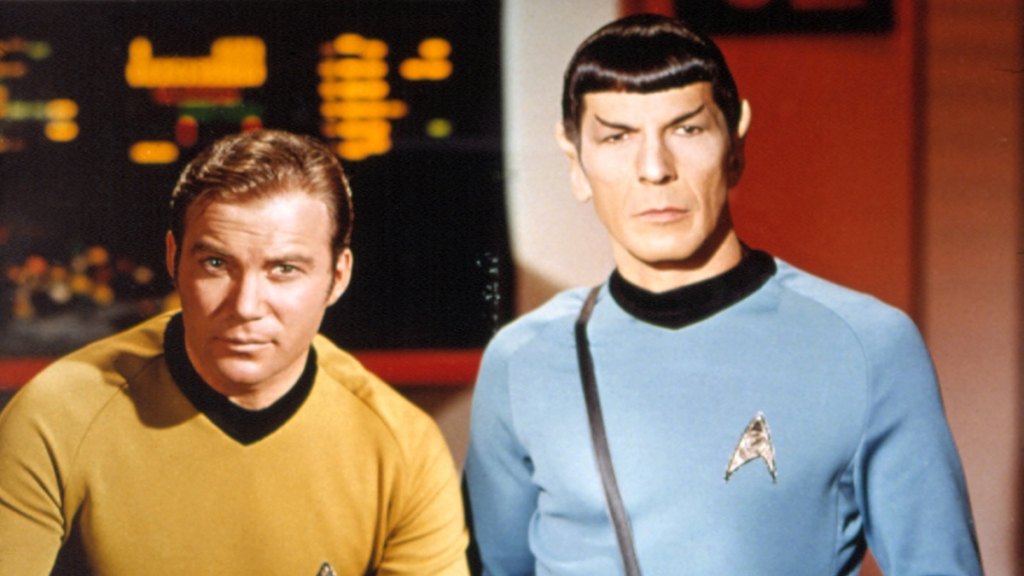
Now, whether this was ego or simply an actor recognizing his growing value and attempting to maximize his position, Nimoy and his talent agency representatives came up with a list of demands—both creative and fiscal—that resulted in the very real possibility that the character would be replaced. Indeed, actor Lawrence Montaigne, who had played a Romulan officer in season one’s “Balance of Terror” and the Vulcan Stonn in season two’s “Amok Time,” was put under contract in early April 1967.
Gene Roddenberry’s near-fateful decision

LAWRENCE MONTAIGNE (actor, Amok Time): “Leonard wanted more money and they negotiated with my agent for me to replace him as another character, not Spock, but with the same background. Then Leonard came back and my agent called me and said, ‘You’re out.’ I was working so much at the time that it didn’t really matter to me, but the idea of joining the show was interesting. They made a very attractive deal. Not as much as Leonard was getting, but it was steady work and I wouldn’t have to go out and audition for roles. I’m one of those actors where I had three shots at series, but none of them worked out, for better or for worse. So I was not very upset or anything.”
MARC CUSHMAN (author, These Are The Voyages): “They almost didn’t have Spock for the second season of Star Trek. The fan mail got so intense during the first year, sacks and sacks of mail every day. His agent said, ‘He’s only getting $1250 a week and he needs a raise,’ but Desilu is losing money on the show and the board of directors was thinking of cancelling it even if NBC wanted to continue because it was bankrupting the studio. So they said, ‘We can’t give you a raise,’ and Nimoy’s people replied, ‘He’s not reporting to work.’”
“[Producer] Gene L. Coon returns from vacation on April 1 and has a memo from Gene Roddenberry that says, ‘Dear Gene: This is not an April Fool’s joke. It looks like we’ll be going forward without Mr. Spock. We’ve hired another actor and he’ll be playing a different Vulcan character on the show.’ It really came down to the wire, and the one that broke the stalemate was the one that didn’t want Spock in the first place: NBC. ‘You are not doing the show without that guy. Pay him whatever you need to pay him to keep him on the show.’”
LAWRENCE MONTAIGNE: “Shortly thereafter, they called me and said they wanted me to play the character of Stonn in ‘Amok Time.’ They sent the script to my agent and he called me and said, ‘I think we’d better discuss this.’ So I went to the office and all of the character’s dialogue was on one page. It didn’t explain that he was a focus all the way through, that he was the guy. But I looked at the five lines and said, ‘I ain’t doing this.’”

“My agent said, ‘Don’t worry, we’ll ask for some ridiculous amount of money and star billing, and they won’t consider it.’ So he calls me back and says, ‘I’ve got good news and bad news. They accepted the deal.’ And I was stuck. I went ahead and did it, it was an easy job. I just had to stand there and look menacing. But the funny part about it is that almost 50 years later I returned as the same character in the [fan] film Star Trek: Of Gods and Men. And Arlene Martel, who played the girl I was supposed to marry in ‘Amok Time,’ performed the marriage ceremony between my character and Nichelle Nichols as Uhura. Star Trek is a small world.”

While Roddenberry and Desilu were united in the notion of recasting Spock, NBC, as noted, ultimately rejected the idea, recognizing the importance of Nimoy’s presence and not willing to alienate the fan base for a show that was, to use the parlance of today’s television-speak, “on the bubble.” In the end, Nimoy’s demands were met and instead of Kirk or Spock being the lead, the scripts increasingly began focusing on them as a team—a dynamic that would ultimately become the emotional and philosophical core of Star Trek itself.
Had things gone differently, the franchise audiences know today might have evolved in a very different direction. The Kirk-Spock-McCoy relationship that became central to the series, the movies and the franchise as a whole almost fractured before it had fully formed. Problem solved? Not exactly. The sense of competition continued, and it impacted the production of the series—as did the actors’ attempts to exert more control on the show creatively. But that’s a different story… available below.
Conversation
All comments are subject to our Community Guidelines. Woman's World does not endorse the opinions and views shared by our readers in our comment sections. Our comments section is a place where readers can engage in healthy, productive, lively, and respectful discussions. Offensive language, hate speech, personal attacks, and/or defamatory statements are not permitted. Advertising or spam is also prohibited.