‘Strange New Worlds’ Was Never Supposed to Exist—And That May Be Why This ‘Star Trek’ Works So Well
Why audiences rallied behind Pike, Spock and Number One—and changed the future of 'Star Trek' forever

Key Takeaways
- Fan demand turned Captain Christopher Pike into the star of his own series.
- 'Strange New Worlds' succeeded by embracing classic 'Trek' storytelling.
- The franchise's future may be uncertain, but Pike's legacy is secure.
At a time when the Star Trek franchise is in limbo, with fans debating its future course while awaiting some sort of official word from Paramount, there’s an irony that’s difficult to ignore: the most broadly embraced live-action Trek series of the streaming era wasn’t even part of the grand plan when Star Trek: Discovery launched in 2017. In fact, Star Trek: Strange New Worlds exists because fans, having been reintroduced to Captain Christopher Pike, refused to let him disappear again.
That point becomes even more remarkable when you consider Pike’s history. Before James T. Kirk became a household name, Pike was the original captain of the U.S.S. Enterprise in “The Cage,” Star Trek‘s original 1964 pilot. Portrayed by Jeffrey Hunter (best known for John Wayne’s The Searchers and the Biblical epic King of Kings), Pike was thoughtful, serious and burdened by the responsibilities of command.
NBC ultimately rejected the pilot, though the network allowed creator Gene Roddenberry to rethink the concept. The result was a second pilot, “Where No Man Has Gone Before,” which introduced William Shatner as Kirk and set the stage for the cultural phenomenon to come.
For many television characters, that would have been the end of the story. Instead, Pike lingered on the edges of Star Trek history. The two-part episode “The Menagerie” repurposed footage from “The Cage,” revealing the tragic fate awaiting the former Enterprise captain. Decades later, Bruce Greenwood revived the role for J.J. Abrams’ 2009 film Star Trek and its 2012 sequel, Star Trek Into Darkness, portraying Pike as mentor, father figure and inspiration to Chris Pine’s young Kirk. But even then, few would have predicted Pike’s biggest contribution to the franchise was still ahead.
Pike and ‘Star Trek: Discovery’
When Anson Mount joined Star Trek: Discovery for its second season, Pike was expected to serve a fairly straightforward purpose. He would temporarily command Discovery, help guide the story and strengthen the series’ connection to Star Trek‘s established history. Instead, he became something far more significant.
Following a first season dominated by war, mystery and Jason Isaacs ’ unconventional Captain Gabriel Lorca, Pike’s arrival felt to many viewers like a return to a more familiar Star Trek sensibility. Whereas Lorca often intimidated the crew, Pike inspired them. He trusted his people, listened to them and led by example.

And the fans responded almost immediately. Just as importantly, they embraced the characters surrounding him. Ethan Peck’s Spock earned praise for balancing respect for Leonard Nimoy’s iconic portrayal with a fresh interpretation of his own, while Rebecca Romijn’s Number One finally became more than the mysterious first officer glimpsed in “The Cage.” Together, Pike, Spock and Number One formed a trio that captured viewers’ imaginations in ways few had anticipated.
ANSON MOUNT: “It was all kind of mind-boggling to me, to be quite honest. I’ve never had a reaction like that to anything that I’ve done, and the results of that response have literally changed my life. It not only gave me a job during a very difficult time for actors, but it gave me the brevity and the opportunity to have a family, and the courage to have to go forward with having a family. Not every actor is in that position. When you choose to go this path, that is a luxury, not a given.” (Entertainment Weekly)
The idea that fan enthusiasm could shape the future of Star Trek wasn’t unprecedented. Fans had campaigned for years to save the series, revive characters and continue storylines. What made the Pike phenomenon unusual was the speed with which it happened. Almost immediately, viewers began asking a simple question: why wasn’t this its own show? And Paramount actually listened.
ANSON MOUNT: “The idea of a Pike show came after we were well done with filming. This was as we were in pre-production for the Trek short [episodes], and it wasn’t even an offer. It was just a conversation between me and [executive producer] Alex Kurtzman. He had a soft green light to write a pilot, and then it was a blur of a couple of years after that, between development and COVID.”
The show fans talked into existence
Moving at warp speed, the resulting Strange New Worlds proved more than comfortable embracing its own identity. While relationships evolved and character arcs continued, the show remembered something Star Trek had historically done better than almost any other franchise: tell a compelling story in a single hour.
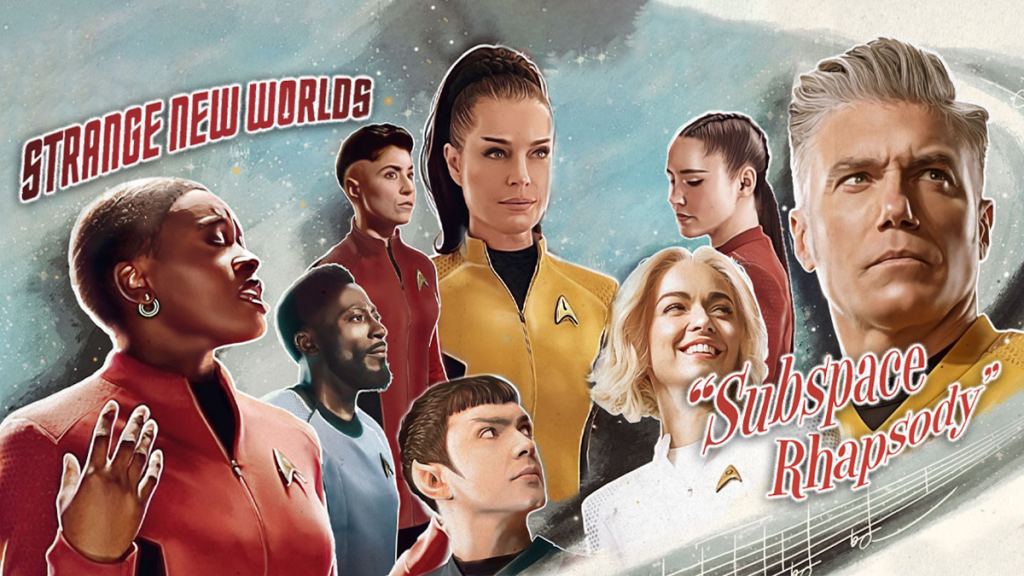
One week brought horror. Another brought comedy. Then came courtroom drama, romance, action and even a musical adventure in the form of the remarkable “Subspace Rhapsody.” And what felt refreshing wasn’t simply the variety, but rather seeing a modern Star Trek series embrace that flexibility again. The show also benefited from changing audience attitudes toward legacy characters.
ANSON MOUNT: “I wanted to do an episodic Star Trek show. That was very important to me. It was also important that we do something that’s based on exploration and fun. I think that everybody was on board with that as well. There was just something in the zeitgeist that people were craving.”
“Now that doesn’t mean that Star Trek can’t be other things. Star Trek can be a lot of things, as we’ve seen in every iteration of it. But classic Trek is really founded on the big idea of the week, and the big idea of the week needs room to breathe. In serialized structure, you’re trying to take care of so many relationships that there doesn’t tend to be a lot of room for that. Now, with that said, I think Discovery does a phenomenal job with that structure and was very fortunate to be part of it. Normally, serialized is my taste, as an actor, but this really felt like it needed to be episodic.” (Collider)
For years, the idea of anyone other than William Shatner playing Kirk or Leonard Nimoy portraying Spock felt unimaginable. Then came the Kelvin Timeline films. Whether fans loved or debated them, Chris Pine, Zachary Quinto, Karl Urban, Simon Pegg and the rest of the cast helped normalize the idea that iconic Star Trek characters could be played by new actors.
That transition wasn’t unlike the James Bond franchise. Once Roger Moore proved audiences could accept someone other than Sean Connery in the role, later Bonds benefited from that precedent. Star Trek experienced something similar as evidenced by the fact that when Paul Wesley appeared as Kirk in Strange New Worlds, viewers were no longer asking whether Kirk should be recast. Instead, they were judging the performance on its own merits.
PAUL WESLEY (actor, James T. Kirk): “Did I feel pressure? Oh my God, are you kidding me? I was, like, ‘Okay, do I do an impression of William Shatner? Do I do my own thing?’ I ended up going, ‘I’m going to do my own thing,’ because it’s free enterprise. I’m going to try to create my own career, maybe have him slowly develop into more of the Shatner version of Kirk. The writers and producers let me run with it. I certainly know this is one of the most iconic characters in the history of television. I don’t take that lightly. It’s a huge pressure. But I’m also going to do what I’m going to do. And some people are going to like it’ Some people aren’t. That’s just all art, ever.” (NY Post)
ETHAN PECK (actor, Mr. Spock): “I hesitate to say that I’ve made it my own. That feels like there’s a little too much ownership there. I’ve certainly done my best and poured my heart into making the character as real and authentically Spock as I can. I think the terror has been diminished by experience and time and maturity, but I still get nervous when I get big scenes and have complex emoting to do. During a very tense moment on the bridge, perhaps, when Spock’s having a realization, there’s something that’s still very challenging to play.” (Inverse)
The same was true of Celia Rose Gooding’s Uhura, Martin Quinn’s Scotty and the growing collection of familiar faces finding their place aboard the Enterprise. Mount, for his part, never attempted to imitate either Jeffrey Hunter or Bruce Greenwood, creating a Pike who felt both familiar and entirely his own. That balance allowed Strange New Worlds to honor Star Trek‘s past without becoming trapped by it.
Building the ‘Enterprise’
From the beginning, viewers knew where Pike’s journey ultimately led: that Spock would survive and Kirk would one day assume command of the Enterprise. The challenge was making the journey compelling even when audiences already knew the destination, the solution revealing itself to be in the form of a character. Spock, Uhura, Chapel and Number One all evolved beyond their original portrayals, while Pike remained the moral center of the series.
As a result, with each passing season, the starship looked a little more like the vessel viewers remembered from the original series. What began as a Pike series increasingly felt like a bridge between two eras of Star Trek, which in turn led many fans as well as the show’s creative voices to wonder what might come next.
AKIVA GOLDSMAN (executive producer): “We started having this idea of those great lost eras that exist in all of our head canon and ancillary canon, but had never really gotten much of a chance to be on the screen. So what we tried to do is reach back to Pike’s Enterprise and instill in it the kind of storytelling values we have today and bring us right up to Kirk’s first day on the job. And we plan to get you there.” (Gamesradar.com)

That idea became known informally as Star Trek: Year One. The concept was straightforward: once Pike’s story reached its conclusion, a new series could follow Kirk’s first year commanding the Enterprise. The transition seemed natural with many of the characters already in place, the sets existing and the cast steadily coming together.
To be clear, Paramount has never officially announced such a project, nor is there any indication that one is currently moving forward. Yet the idea remains persistent because Strange New Worlds has spent years laying the groundwork for it. Every appearance by Kirk, every step in Spock’s evolution and every addition to the familiar Enterprise family encourage viewers to imagine what lies beyond Pike’s tenure. After all, Star Trek history is filled with projects that never moved beyond the discussion stage. Fans spent years hoping for a Captain Sulu series, while more recently, many have championed Star Trek: Legacy as a follow-up to Picard.
And while it’s true that enthusiasm alone guarantees nothing, if Strange New Worlds has demonstrated anything, it’s that the future of Star Trek rarely unfolds exactly as expected. As noted, when Star Trek: Discovery premiered in 2017, Christopher Pike was little more than a familiar name from franchise history. Few could have predicted he would become the centerpiece of one of the franchise’s most successful modern series.

Yet here we are. A character introduced in a rejected pilot spent decades living in Kirk’s shadow before finally stepping into the spotlight himself. Along the way, Pike helped inspire a series that embraced exploration, optimism and adventure while introducing a new generation to the crew of the Enterprise.
Now, as Star Trek: Strange New Worlds winds down with its 4th and 5th seasons already filmed, fans continue to speculate about what comes next. Whatever may happen, Pike’s place in Star Trek history already feels secure. Not bad for a captain who was never supposed to get a second chance.
Season 4 arrives on Paramount+ July 24th
Conversation
All comments are subject to our Community Guidelines. Woman's World does not endorse the opinions and views shared by our readers in our comment sections. Our comments section is a place where readers can engage in healthy, productive, lively, and respectful discussions. Offensive language, hate speech, personal attacks, and/or defamatory statements are not permitted. Advertising or spam is also prohibited.